D-Day+81 – Why they fought
D-Day – the 6th of June, 1944: “The Longest Day,” as it was called in the classic 1962 film of that name. Then came “The Americanization of Emily” (1964 – D-Day+30). And “Saving Private Ryan.” (1998). Unforgettable images of Americans storming Normandy’s “Omaha Beach,” dying in the water, dying on the land, scaling those impossible cliffs to overtake the German defenses and go on to win the war in Europe. The war against fascism. The cause for which they fought resonates today on these shores, so it is worth recalling their battle and their sacrifices as they fought and died for liberty.
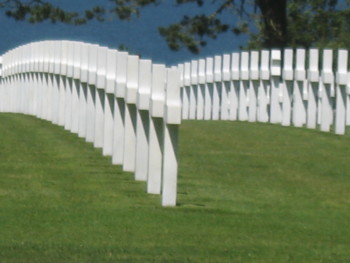
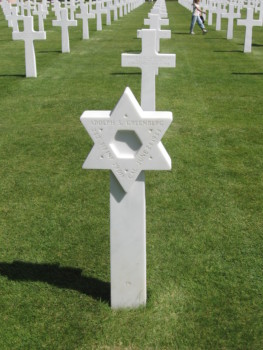
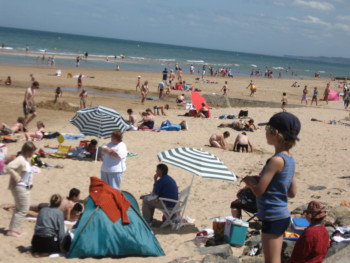
In 1994, on D-Day’s 50th anniversary, I was privileged to tell their story in The Washington Post through interviews with the veterans of that bloody, terrible and ultimately triumphal day. Fourteen years later, my wife Sandy and I visited Omaha Beach, by then a family vacation spot, and also the nearby American cemetery, a solemn place where there are 9,388 grave sites of the fallen Americans. The grave markers were mainly crosses, but there were also Stars of David to indicate that Jewish Americans also fought and died there. We left stones to remember and memorialize them.
In earlier blog posts, I reprised my D-Day story, and I do so again here.
“They Survived a Beach Called Omaha,” which ran in the Washington Post on May 30, 1994.
What they remember most is the chaos – units landing in the wrong place, their guns and tanks sunk at sea, and unexpectedly severe firing from the high bluffs above.
And on the beach, no cover. The bombers had dropped their payloads inland instead of on the beach to create craters for hiding. At first, the Navy guns also were misdirected. And in the water and on the beach, the waves of soldiers kept coming and kept dying.
“The beach was strewn with dead and dying and equipment,” remembers William Friedman, 77, a retired Army lieutenant colonel who lives in Northwest Washington.
“It looked like all the debris in the world had been gathered up and thrown on that beach.”
It was both the highest and lowest point of their lives. It was a time best remembered and best forgotten. It was D–Day, the largest amphibious invasion in military history, the Normandy landing that skirted disaster, the one they survived to tell about.
For the 50th anniversary, some are going back one last time, to commemorate the battle they won and memorialize the comrades they lost. Others, hobbled by the infirmities of age or disinclined to dwell on the traumas of war, are staying home.
They are men who have lived almost a lifetime since June 6, 1944 – men such as Jim Lipinski, of Alexandria, who married a Holocaust survivor of a labor camp he helped liberate and remained in the Army an additional 17 years; Frank Bowen, of Rockville, who helped rehabilitate soldiers in a military hospital in England, fought in the Korean War and later had a career with IBM; and John Finke, of Fort Belvoir, who stayed in Germany during the occupation and worked for the Office of Strategic Services, forerunner of the CIA.
Yet for most, the passage of time and the intervening events have not dimmed the memories of Omaha Beach.
“At Omaha Beach in the morning, it was as bad as combat has ever been,” historian Stephen E. Ambrose says. “You had companies taking 96 percent casualties in five minutes. The volume of lead and steel coming down on the men of Omaha was certainly as much as Pickett’s men faced at Gettysburg.”
A large share of those troops came from Maryland and Virginia. The assault on Omaha consisted of soldiers from two infantry divisions: the 29th, formed from units of the Maryland and Virginia National Guard, supplemented by draftees from all over the country and untested in battle; and the 1st, veterans of the North African and Sicily campaigns.
The combined force of 35,000 would suffer about 3,000 casualties that day, including more than 2,000 dead.
By D–Day plus 11, the Allies had 487,643 men and 89,728 vehicles ashore, achieving the dramatic success that historians have described as the beginning of the end for Hitler’s Third Reich.
But the men who landed at Omaha on the first day remember an invasion that had all the markings of failure.
Friedman’s outfit, the 1st Division’s 16th Regiment command unit, landed roughly on schedule at 8:15 a.m., but not “where we were supposed to. Worst of all, we didn’t know we were going to meet opposition. Our intelligence showed us coming in on an unoccupied beach … with resistance inland.”
Because of the fire from the beach, landing craft ramps were lowered as much as 100 yards off shore in water sometimes neck-deep. Laden with rifles, packs and grenades, men “went down plumb to bottom if slightly wounded,” their equipment sinking to the bottom, Friedman recalls.
“When we landed … there was no movement at all. We were all just exposed, under intense fire, clear observation. The tide was pushing us onto the beach, and the beach was mined. Talk about the true meaning of being between the devil and the deep blue sea; this was it. I was in a mass of human bodies, dead, alive, wounded.”
Lipinski, now 72, was the regimental warrant officer. Of the 102 men crowded onto his landing craft, 35 were killed before they reached the beach.
The landing craft faced a German machine gun nest “raining a hailstorm on the front ramp before the ramp was even lowered,” Lipinski says. “I got away from it because I went over the side and not over the ramp.”
It was low tide, and Lipinski waded to a sand dune in front of the beach and crouched behind it. There he found three others from his company.
“I started them over the dune one at a time,” he says. “Then I went over, and all three of them were lying dead on the other side.”
Whatever could go wrong did, it seemed. Arthur Van Cook, 75, a Bronx native who now lives in Springfield, was a lieutenant with the 29th Division’s 111th Field Artillery Battalion, which was supposed to provide support for the 116th Infantry. It took three boats to get him to shore. The first amphibious craft sank as it came off the landing ship; a second one also went down. By then, there was almost no artillery left.
“My battalion had the distinction, if you can call it that, of landing without any guns,” he says. “All our field artillery pieces were sunk, out in the water, gone, except one.”
They did what they could with what they had. As the veterans tell it, leaderless men from different units found each other and fought together on the beach. In some cases, commanding officers remained with their units and issued memorable send-offs.
“There are two kinds of people on this beach,” Friedman remembers his regiment’s commander, Col. George Taylor, saying, “those who are dead and those who are going to die. Move in and die.”
Finke, 83, a captain and rifle company commander in the 16th Regiment who now lives in an Army retirement community at Fort Belvoir, had broken his ankle in England three or four days before D–Day. But he hid his injury so he could be part of the invasion.
He rode in the lead landing craft with a bandaged ankle and a cane, then used the cane to prod his men past the mined pilings and other obstacles that lay between the water and the beach.
“If I hadn’t gone ashore, 200 soldiers would’ve disappeared because they didn’t want to go to shore,” he says. “I hit ’em in the ass, kicked ’em in the ass. I was just their old man.” Later that day, a mortar shell broke his elbow and ripped his leg, his fourth wound of the war.
Van Cook remembers that when he informed his commanding officer there were no artillery pieces, he was ordered to round up as many artillerymen as he could find on the beach and tell them to use their rifles and bayonets instead.
What finally saved the day, more than one veteran says, was the Navy. Misdirected at first, the Navy guns offshore eventually found their targets, the German gun emplacements on the cliffs.
Recalls Van Cook: “Some battleships out there firing 16-inch guns … did a number on those {German guns} looking right at us. If not for those birds, we might still be there.”
By late afternoon, Van Cook says, “you had 155-millimeter howitzers coming in and the tanks. You had to get the hell off that beach or get run over by your own stuff.”
Erman T. Clay came over two days later.
In those days of racial segregation in the armed forces, the D–Day assault troops were all white (although some Native Americans were in the first wave of parachutists to land in Normandy).
Clay, 71, who grew up on the Potomac in Southern Maryland and now lives in Northeast Washington, had been drafted into the 1st Division’s all-black 544th Quartermaster Battalion.
His job in England had been to waterproof vehicles for the landing.
On the way to Normandy, his ship was bombed and strafed but for the most part unharmed. By then, enough land mines had been removed for the troops to follow a four-foot path across the beach.
“On each side, all you could see was dead men stacked up like cordwood,” he says. “They would bring us in, take a load of them back. Your first thought is you want to get in and do bodily harm to the folks who killed your soldiers.”
But that wasn’t his job. Instead, Clay and his company unloaded trucks, stacked ammunition, guarded prisoners of war.
“We’d see these other units coming in, going on to the front,” he recalls. “We felt we needed to be a part of that. But it didn’t stop us from doing the job we were doing.”
The war ended. They came home, raised families, pursued careers in and out of the military.
Most were eager to put the war behind them, to marry, to get an education, a postwar house, a piece of peacetime America – the dream for which they’d fought. They did not talk about the war much, they say, or about D–Day. There was a reticence, almost an unspoken understanding that the horrors of D–Day were best left behind on Omaha Beach.
Long after D–Day, Lipinski gave his son copies of his Silver Star recommendation and a report about his landing craft, “but he didn’t seem to follow up with questions… . We’ve never talked about it. Mostly, I talked with other soldiers.
“My personal memories, I must have put them out of my mind” until the recent focus on the 50th anniversary, Lipinski says. “I sort of blacked out the whole Omaha Beach. I suspect a lot have.”
For some veterans, the whole 80-day Normandy campaign has become something of a blur. Robert T. Cuff, 83, of Ashton, who was in the 29th Division, isn’t sure which day he landed in Normandy. What he recalls is that “we were just a target for the Germans on the hill. … They fired at us all the way to the Elbe River.”
Bowen, a captain who commanded Company C of the 115th Regiment, thinks mostly about the narrow escapes, like the shell that landed seven feet away when he was standing on the bluffs above the beach. It gave him a bad concussion, but it killed the sergeant standing next to him and severed the body of one of his other men.
“It was something I won’t be forgetting as long as I’m able to think,” says Bowen, 81, who was wounded by machine gun fire six days later. But, he adds, “I don’t spend a lot of time thinking about it.”
“We felt fear, and then we didn’t feel,” Friedman says, recalling the long ascent up ravines from the beach to the bluffs. “We were emotionally drained when we got to the top of that hill.”
Most of the veterans do not express deep thoughts about D–Day‘s historic significance or how the combat affected them. It’s enough, they suggest, to say this: They survived, and many didn’t. For their own survival, they give thanks; for those who didn’t make it, they mourn still, and perhaps even more so now that all eyes are again focused on the beaches of Normandy.
Several thousand American veterans of World War II will be going there this week to commemorate the invasion. The 29th Division Association is returning en masse: A total of 485 people, including 230 Normandy veterans, have chartered 10 buses for a full week of scheduled events. First Division veterans are going back in smaller groups.
Clay, who worked for the Veterans Administration and the Treasury Department after the war, returned with his family on the 25th anniversary. When he looked at the beach again, he says, he was even more struck by the odds the troops faced. “I couldn’t see how it was possible for us to get in, with all the ammo and pillboxes and 88s the Germans had,” he says.
Lipinski has never gone back to Normandy and isn’t going this year. “I just never had any desire to,” he says. “One time was enough for me.”
Van Cook has been back to Europe many times, but never to Normandy. “I always pictured it full of rubble and bodies,” he says, “and I didn’t need to go back to see that.” But he is going back for the 50th, figuring that he won’t get another opportunity.
So is Friedman. “I think this is sort of a last chance at nostalgia,” Friedman says. “Things like the beach tie you together, you know. We realize fully this is really rather the last hurrah.”
Copyright The Washington Post Company May 30, 1994
+++
The Capital Jewish Museum: It’s personal. So many thoughts. Two of my sons are fifth generation Jewish Washingtonians, and our family has donated items to this museum, which is more than a collection of artifacts. The old synagogue around which the current museum was built was the first building to house Adas Israel, a Conservative congregation where my wife’s relatives worshipped at the beginning of the last century and where, in 1987, we were married. The murder of a couple emerging from a “Young Diplomats Reception” held to discuss “humanitarian diplomacy” and bringing such aid to the Middle East and North Africa was not a random crime. And that the engaged couple happened to be employed by the Israeli embassy here, around which much of the coverage centered, didn’t matter. They were simply Jews. The alleged assailant cried out “free. free Palestine” as he entered the museum after he had committed the deed and later said, “I did it for Gaza.” Once again, all Jews are being held responsible for the actions of a foreign government of which they may or may not approve. In the world of Jew hatred, there is no nuance; it simply does not matter. The peaceful “Free the Hostages” marchers in Boulder, Colorado were similarly stereotyped. Their views on Israeli attacks in Gaza are unknown, and irrelevant. They were presumed to be Jews, and that was sufficient probable cause for a pro-Palestinian flame thrower to seek their destruction. That he had overstayed his immigrant visa is also irrelevant. The man charged with murder at the Capital Jewish Museum is a native Chicagoan. The crime is violent antisemitism, pure and simple.
Finally: See you on June 14, in small towns and big cities, along highways and in public squares, and wherever freedom still rings, where FDR’s Four Freedoms enunciated in 1941 are still relevant: Freedom of speech and expression, Freedom of worship, Freedom from want, and lastly Freedom from fear. It is patriotic to protest. June 14 is also Flag Day, marking Old Glory’s adoption in 1777. It’s not a day for showy military parades down Pennsylvania Avenue or to wish #47 happy birthday. It’s an American holiday. If you wish, don’t be ashamed or hesitate to fly the red, white and blue. It belongs to all of us.
Great article Gene. Heartbreaking to think of the disdain the present regime has for that profound sacrifice.
Well said, as always, Gene-O.
One place where freedom doesn’t ring is in DC. But that was to be expected.
Thank you Gene for again sharing that poignant D-Day piece and keeping alive the memory of the soldiers’ sacrifice.
On Adas Israel, I wrote a piece for the Post when it became a museum (known as the Small Museum then) and the actually small synagogue’s future, once rocky and even rolling (!), looked secure at last. I did not know till I read your reflection the topic of the discussion that night.