AIN’T NO BACK TO A MERRY-GO-ROUND
My final edition
No, not of this blog but as the editor of B’nai B’rith Magazine, the eclectic Jewish magazine I’ve been proud to helm for 16 years. The current Winter 2025 issue is my last as the editor. The cover line “Ain’t No Back to a Merry-Go-Round” is from a Langston Hughes poem and is the title of a documentary film released a year ago that tells the story of how Black Howard University students and white, largely Jewish suburbanites joined in 1960 to protest segregation at the Glen Echo Amusement Park in Bethesda, Maryland. The park integrated the following spring. Over the years, our cover stories on my watch have included Gays and Judaism, Jews of Color, Intermarriage, Jews and Muslims in America, Jewish Arabs: the Reluctant Exiles, Iran in Latin America, Jews in the Civil Rights Movement, Anti-Social Media, Gourmet for Passover, Uncovering UNWRA. To see any of these stories and entire issues, click here for the magazine’s archives.

B’nai B’rith was founded in 1843 in Manhattan by a dozen German Jews to advocate on behalf of all Jewish citizens, native-born and immigrants. The institution fosters subsidized housing for seniors, fights antisemitism, generally supports Israel but does not editorialize on behalf of its government. A section of the magazine “Impact” is the institutional newsletter, separate and apart from editorial content.
As the longtime editor of B’nai B’rith Magazine, I was recently confronted at an authors dinner by someone who demanded to know my views on Gaza. It was a hostile, not a friendly question. I demurred. We don’t do politics, I said. He said nobody’s talking about Gaza. I said many people are talking about Gaza, and let it go at that. Which did not satisfy him. Our biannual authors dinner (this was #68 — “the Ballroom Edition”) is supposed to be Switzerland: No Politics. But this blog isn’t Switzerland. So, here goes:
There is much more than Gaza, the West Bank and the seemingly interminable Mideast conflict to Jewish history, culture, religion and life. The magazine has reflected that. The president’s message in the magazine has generally been anodyne, to boost the organization without alienating anyone. But Robert B. Spitzer, the current president of B’nai B’rith International, had an important message that takes a strong stand against the Trump administration’s anti-immigrant, xenophobic policies. So I couldn’t be prouder than to have his column in my final issue as the magazine’s editor. Under the headline “We Were Immigrants,” Spitzer wrote:
“Many of those deported have been sent to dangerous places that were not their homes, such as Sudan, Somalia, Venezuela and El Salvador. Tens of thousands waiting to be deported are being held in prisons, such as in the new ‘Alligator Alcatraz’ established in the Everglades in Florida and Guantanamo in Cuba. Families are being torn apart, and the administration is denying the validity of a concept which every federal court has ruled is enshrined in the Constitution–that people born in the United States are U.S. citizens.
“Is this the America my grandparents called the ‘Goldene Medina?’ Is this extreme hostility toward foreigners good for American, which has long been a magnet for the best and brightest of the world to come to our universities and who stay to create scientific, medical and technological innovations? Is it good for the Jewish people, who are often targeted when waves of hostility are directed at minority groups?
“Does the current backlash reflect America’s aspirations? Have we forgotten the words engraved on the Statue of Liberty taken from a poem by the Jewish American poet Emma Lazarus: ‘Give me your tired, your poor, your huddled masses yearning to breathe free’?
“As Jews, we are reminded every Pesach that we were slaves in Egypt, to reinforce our sense of empathy toward the downtrodden. The patriarch Abraham was famous for his understanding and actualizing of the commandment ‘loving the stranger,’ which appears 36 times in the Torah.
“We are living in profoundly divisive political times. Notwithstanding our differing news sources, political affiliations or countries of residence, our history as Jews as well as our religious values need to inform our lives and actions. While it is important for America and every country to defend it’s borders, let’s not lose sight of how we’ve been taught to treat strangers in our land.”
ICYMI
Sadly, Tom Stoppard, the brilliant Czech-born British playwright, died the other week at the age of 88 at his home in Dorset, England. “Sir Tom” was a best friend to the late Andre Previn, the musical polymath — composer, conductor, jazz pianist and Hollywood music man — and my cousin. Fortunately, I was able to interview Stoppard in August 2023 for the Andre Previn biography that has long been my work in progress. Here’s a link to my essay, which was published by the online Washington Independent Review of Books.
Post-ed
A former Washington Post colleague has alerted me to a new job opportunity at the newspaper. The job title is “Creator Host” and the pay range is $149,00 to $278,300. Nice work if you can get it, as the song goes. But what’s it all about, Alfie? For every detail, click here. For the snarky blogger’s version, read on. “Join the future of news,” the posting begins. So far, so good. “At The Washington Post, you’ll help reinvent news.” Reinvent news? Funny, I always thought a newspaper is supposed to cover — not reinvent — news. The Post is “building WP Creator — a bold new space for the knowledge experts, innovative storytellers and builders shaping the future of media and influence.”
How is that for corporate word salad? Excuse me, but isn’t an expert presumed to be someone with knowledge? As a result of “storytelling, insights and community engagement,” you can help make the WP “an essential home for anyone building in the creator space.” I always wanted to build something somewhere, in space or preferably on Earth. Then there’s some mention of “the authenticity and energy of (italics mine) creator culture.” What does that even mean? Want to be “a trusted voice in the (italics mine) creator space?” To borrow from that most authentic wordsmith, Casey Stengel, can’t anyone here in this “creator space” write in plain English?
On the other hand, and to be fair and balanced and apply a bit of both-siderism, I must commend the non-opinion side of my former newspaper for some outstanding reporting and writing not available elsewhere–and the reason I continue to subscribe to the rag. Well, for online only readers, I guess the word “rag” may no longer apply. But I digress. The Sunday Style profile of Rosie O’Donnell, living the expat life in her ancestral country of Ireland is well worth the time and the amount of space devoted to it. The print Sunday front page also contained some must-read stories that were revelatory in a accountability-reporting way (such phrases are now de rigueur in the media space). The off-lede (upper left column in the print edition) was a deep dive into the Trumpificaiton of the Kennedy Center. The lede story (upper right hand column) was an extended “take-out” (legacy newspaper term) into the tragic reality of Trump’s mass deportation troops detaining citizens along with the undocumented, with a focus on the ICE sweep targeting and terrorizing Chicago-area neighborhoods. Not in the Sunday paper but also relevant is Karen Tumulty’s piece harking to the xenophobia of the 1920s and how history is repeating itself.
A solemn anniversary
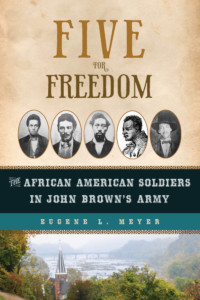
On Dec. 2, 1859, the radical abolitionist John Brown was executed for leading an attempted slave insurrection at Harper’s Ferry, a federal arsenal town where his small army of 18 — including five African Americans — seized the arsenal and rifle works and briefly held the town hostage before 90 marines, led by Col. Robert E. Lee, ended the siege two days later. On Dec. 16, 1859, four of the men, including two of the Black insurrectionists, Shields Green and John Anthony Copeland, were also duly executed, hanged in Charlestown (now Charles Town, West Virginia). The judge and the jurors were all slaveholders. In 2018, I published Five for Freedom: The African American Soldiers in John Brown’s Army, which tells the long-forgotten story of the brave Black men who sought with Brown to abolish slavery. The book is not “breaking news,” though its contents may still be news to some. To read more about it, and to order a copy, click here.
Soon, I expect the lede story in the Post to be about the blue sky we had yesterday and what to expect tomorrow , and the off-lede to be about gluten-free cookies.
I did particularly appreciate your quoting Robert Spitzer. Thank you.