Democracy Dies in Darkness. Indeed!
As I write this, I am reading about the utter destruction and decimation of the Washington Post staff by Jeff Bezos, the billionaire owner of the newspaper since 2013, who now, in 2026 couldn’t care less about Washington’s former local paper of record and voice of conscience through the dark days of Joseph McCarthy, Watergate, and Trump 1.0. The executioners doing his bidding are a cadre of product-killers who were supposed to save the paper, not destroy it.
I joined the paper in 1970 and stayed until 2004, through the Pentagon Papers, through Watergate, through the best of times and sometimes the worst of times. I proudly bore the byline as a Washington Post Staff Writer. Mostly, I worked in Metro, but my stories appeared in every section, including many in Style, covering the Enola Gay controversy at the Smithsonian, and on many long features, some of them edited by the legendary Gene Weingarten, and in Weekend, under the former longtime local columnist, colleague and friend John Kelly.
Others, notably former Washington Post Fact Checker Glenn Kessler, have charted the paper’s editorial decline as Bezos-hired henchmen sought the secret sauce to turn a sacred public trust impossibly into a cash cow to satisfy the whims of its billionaire owner, who’s more interested in rocketing into space than what is happening on earth. What happened today, a precisely 8:30 this morning via Zoom to an imperiled staff, was nothing less than an epic tsunami. The impersonal message was delivered by Matt Murray, the executive editor. Publisher Will Lewis was AWOL, nowhere to be seen. (But not entirely. He was in San Francisco walking the NFL “red carpet” before the Super Bowl. Murray reportedly didn’t know.)
Truth and consequences: The recently revived Book World–gone! Most foreign bureaus, including those covering the Middle East, India and Ukraine–gone! Lizzie Johnson, in Kviv, laid off “in the middle of a war zone.” The paper’s investigative unit–seven laid off. The vaunted sports section–obliterated! The already downsized local staff, further diminished from barely consequential to virtually inconsequential. Who will turn out the lights?
Bezos once blessed the masthead slogan: “Democracy Dies in Darkness.” With the destruction of a once great newspaper, the light grows dimmer and dimmer.
Even the ageless prose poet Martin Weil, who just marked 60 years at the newspaper with some 200 notes of appreciation from former colleagues, was laid off. Erik Wemple, who covered the media for The Post for 14 years before joining The Times last year, has written a moving piece about Marty. Made me cry.
Stories about the layoffs have appeared on multiple websites, in addition to a long story in The New York Times. But so far there is nothing in The Washington Post — except for a full-page house ad the day after directed “TO OUR SUBSCRIBERS” that obliquely states, “You may have read about the restructuring we are undertaking at The Washington Post,” and pledging to “continue to enhance the product… keeping [it] strong,” by — wait for it – buying a new printing press!
Ruth Marcus, my former colleague who entered the Post via its Prince George’s office, when I was bureau chief, posted today in The New Yorker.
From Ashley Parker, another former star WP reporter now at The Atlantic: “We’re witnessing a murder. Jeff Bezos, the billionaire owner of The Washington Post, and Will Lewis, the publisher he appointed at the end of 2023, are embarking on the latest step of their plan to kill everything that makes the paper special. The Post has survived for nearly 150 years, evolving from a hometown family newspaper into an indispensable national institution, and a pillar of the democratic system. But if Bezos and Lewis continue down their present path, it may not survive much longer.”
From my friend and former Post colleague Peter Baker, now the Times chief White House correspondent: “No struggling newspaper ever saved itself by becoming a worse and less essential product. But what’s happening today at the @washingtonpost is not just the latest devastating contraction of the news industry; it’s the gutting of an American institution vital for a healthy society. For my money, the @washingtonpost sports section has been the best in the country, its foreign correspondents some of the bravest and most exceptional in the world, its metro coverage indispensable to a major region and its book section one of the first things I read on Sundays.”
This note from Marty Baron, executive editor for eight years when Bezos seemed to have a moral compass that supported the paper’s defiant slogan: “This ranks among the darkest days in the history of one of the world’s greatest news organizations.”
Don Graham, who sold the paper to Bezos with high hopes for its future, had refrained from commenting on its decline. But today he wrote on the Washington Post Alumni Facebook page: “It’s a bad day. I am sad that so many excellent reporters and editors—and old friends—are losing their jobs. My first concern is for them; I will do anything I can to help. I will have to learn a new way to read the paper, since I have started with the sports page since the late 1940’s. I will always want the Washington Post to succeed—and you should too. It makes a difference. The paper has another strong, stand-up editor in Matt Murray. And it still has a great staff.”

FYI, the Washington Post Guild has launched a “Washington Post 2026 Layoff” GoFundMe site, with a goal of raising $600,000 for former employees.
What on Earth!
Washington Post print subscribers might have noticed an insert with the Sunday paper. It was a promotion for a young adult supplement of “America As It Happened: Part 1, Earliest Time to Colonization,” somehow linked to the upcoming 250th anniversary of American independence. Oddly, the timeline that runs across the bottom throughout omits a key year: 1619. That, of course, was when the first enslaved people arrived in Virginia. This foundational year was key to the New York Times 1619 Project, which posed that our history began not in 1776 but with the introduction of slaves in the British colonies. The entire back page of the promotional insert is sponsored by “The Trump Kennedy Center,” with Kennedy-Center.org, “The ONLY OFFICIAL WEBSITE of the Trump Kennedy Center.”
It turns out that “What on Earth!’ is the product of a UK-based company (rather ironic celebrating the American Revolution) that is published by the UK-based Toucan Books, mostly for young adults. The text is copyright by What on Earth Publishing, Ltd. and there appears a long list “For The Washington Post,” starting with masthead names (William Lewis, Publisher & CEO), and descending to those of many staffers, who may or may not have been laid off. Among them is Toluse “Tolu” Olorunnipa, a Pulitzer Prize-winning journalist and author who is now on the staff of The Atlantic.
“Pioneers of the Press.” A book–and a legacy to honor and uphold
This blog I posted last September seems even more important and timely.
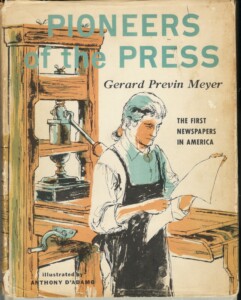
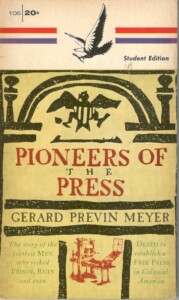
Sixty-five years ago, my father Gerard Previn Meyer wrote a book called “Pioneers of the Press.” The publisher was Rand McNally, and the book, republished in paperback as a Fawcett Publications “Student Edition,” was translated and reprinted in several languages and distributed abroad by the U.S.I.A., the U.S. Information Agency. In 1999, during the Clinton administration, the USIA was subsumed into the State Department, along with the Voice of America. This year, President Trump by executive order abolished the agency and fired virtually all of its employees, whose mission it was to further democracy abroad.
At the time my father’s book appeared, the McCarthy era with its red baiting and blacklisting was basically over and an attractive young president was ushering in a “New Frontier” with all the aspiration and inspiration it promised to bring. “Uncle Walter” Cronkite, Huntley and Brinkley, and Howard K. Smith from the three major networks brought us the news, along with several top traditional print newspapers. The civil rights movement was just beginning to stir but was not yet fully stirring. The worst was yet to come, but who knew or could predict that at the dawn of a hopeful new era? I was just 19. No wonder they called us the silent generation.
The somewhat snazzier paperback cover virtually shouted: “The story of the fearless MEN who risked PRISON, RUIN and even DEATH to establish a FREE PRESS in Colonial America.” The purpose of Public Occurrences published September 25, 1690, the first American newspaper, was “That people everywhere may better understand the circumstances of publick affairs.” The back book jacket goes on to explain that four days later, “all copies of the paper had been burned, [publisher] Ben Harris was facing a Colonial tribunal, and the free press of America had suffered its first defeat. But the idea of an independent newspaper could not be destroyed, and before long there was another courageous editor, another and yet another, all of whom fought for the right to print the truth as they saw it.”
My father wrote: “To GENE and DEBBY, my son and daughter, and their generation, pioneers of the future, I dedicate this tale of pioneers of the American press who helped to form the great tradition of freedom and truth which they now proudly inherit.”
Currently, when the truth is derided as “fake news” and publishers cower before a wannabe king, Pioneers of the Press could not be any more timely. Sadly, it is no longer in print, and only a few pages are available to see on the nonprofit Internet Archive at Archives.org. But the book should be required reading for all Americans, and on. every public school reading list, as a timely reminder of why what what we journalists do, when we act with courage and conviction, matters for everyone, now more than ever.
Gene,
It’s a sad day for the country. You nailed it with “who’s more interested in rocketing into space than what is happening on earth.”
Gene – I was so angry after Bezos interfered with the Post’s endorsement for President before the 2024 election, I stopped getting the paper. I only renewed my subscription a few months ago. Now I’ll let go of it again. My main reason for resubscribing was for local news and also the much reduced Book World. As is often said, there is a special place in Hell for ________ – and I’d put Bezos in the blank space.
Well said, Gene-0. . . . But very, very sad. The Post died two days after Myra.
The Post was doomed from the day it was sold to Bezos. It should never have gotten into the hands of someone with that much power. Were the owners so desperate that they couldn’t wait a little longer to find a buyer more likely to sustain and grow one of America’s great newspapers??
This is such a tragic story. I have felt the ground shifting under me this week first with news of the Kennedy Center’s demise and now the gutting of the Washington Post. Everything I had thought was solid and institutional is now suddenly decimated. My heart goes out to you for the loss of your beloved paper. As a musician, I have felt similarly about the Kennedy Center.
These are not good signs for democracy.
I am so proud of you and your family. My grandfather, Leo Previn and his brother Charlie, as you know brought Andre to this country. My brother Ted’s grandson, Andre Previn Peck inherited Andre’s genes and now, at age 15 has the played the piano with orchestras in Wisconsin. How is the book about Andre progressing? Roz