Juneteenth Is Still Relevant
Lest We Forget!
The slogan, invoked by unreconstructed rebel defenders of “the lost cause,” referring to the defeat of the Confederacy by the Union 160 years ago, has suddenly taken on new meaning and relevance, but not in the way it was originally intended.
From the pronouncements and policies of the Trump administrations, you would think the South had won the war — and the peace! There has been a conscious erasure of history in banning diversity, equity and inclusion — not only the policies that seek to advance the aspirational goals of our country but even these words and many others that recall and celebrate the triumphs achieved and the challenges overcome in the ongoing struggle for justice.
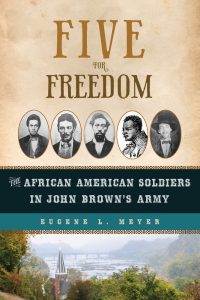
One such effort to overcome was underway in the spring and summer of 1859 when abolitionist John Brown was preparing the conduct a daring raid on the federal arsenal town of Harpers Ferry. His plan was to incite a slave insurrection and, with seized arms, wage guerilla warfare from the nearby Appalachian mountains on the slaveholders and their plantations in the valley below. Among the 18 men who went with him to the Ferry that October were five African Americans, whose stories I tell in my book Five for Freedom: The African American Soldiers in John Brown’s Army. Of the five, only one, Osborne Perry Anderson, survived. This sole survivor wrote the only insider account of the raid that historians have called the spark that led to the Civil War, and ultimately the abolition of slavery and three implementing constitutional amendments that, remarkably, are being challenged anew more than a century and a half later.
Juneteenth, a federal holiday since 2021, marks the date in 1865 when the enslavers in Texas were ordered to free all of those who they had held in bondage. This was 2 1/2 years after Lincoln issued the Emancipation Proclamation that applied to states under rebellion — including Texas — and two months after the Confederate Gen. Robert E. Lee had surrendered to Ulysses S. Grant at Appomattox Courthouse and the North had seemingly won the Civil War.
It’s been my privilege and honor to review several books harking back to that era for The Washington Independent Review of Books. I believe they remain relevant, and I think you might find them of interest. Below are titles with links to my reviews.
Longstreet: The Confederate General Who Defied the South
Nat Turner, Black Prophet: A Visionary History
The Rise and Fall of the Second American Republic: Reconstruction, 1860-1920
A Madman’s Will: John Randolph, 400 Slaves, and the Mirage of Freedom
The Failed Promise: Reconstruction, Frederick Douglass, and the Impeachment of Andrew Johnson
Black history in Maryland
For eight years, from 2005 to 2013, I wrote a “Hidden Maryland” column for Maryland Life magazine, which published its last issue in July 2013. Several columns were about Black life, now and then. The digital archive died with the magazine, but I have published columns, features and profiles illustrated and with updates in Hidden Maryland: In Search of America in Miniature, which is available in paperback, on audio and as an e-book.
Recent YouTube interviews on Black History:
FIVE FOR FREEDOM – I trace the stories of the five men who fought with John Brown at Harper’s Ferry in 1859 in a visit to Sotterley’s slave cabin in Southern Maryland, on Feb. 28, 2025. To watch, click here.
My interview on Five for Freedom on the “Rock Paper Write” podcast posted on Dec. 12, 2024. To watch, click here. This is one of a series of interviews with Amy Watkins for the Kensington Row Bookshop.
***
Lest We Forget.
***
Happy Juneteenth!
Excellent. You are exactly right. The attempts to reverse the results of the Civil War — with President Trump announcing he was bringing back the fort name for Robert E. Lee — is an abomination.
Well, a couple of tangents, tangents seem to be my specialty. Your post reminded me of the song by Billy Taylor, who grew up in DC and frequently appeared on CBS “Sunday Morning,” my point of contact: “I Wish I Knew How It Would Feel to Be Free.” And “On Juneteenth” was written by historian Annette Gordon-Reed, who is from Texas. Since I saw her on “Morning Joe” in 2021 when the book came out, with no evidence I have imagined that the “Gordon” of her name somehow connects with the name of the Union general.
The most stunning, amazing, unbelievable, but clearly obvious aspect of Trump’s crusade to unwrite American history is how easy it has been. But don’t worry. We voted the last time, but we won’t ever have to vote again. He promised. To “unwrite” is easier than to “unsee,” as it turns out.