The Conscience of a Conservative
“Extremism in the defense of liberty is no vice. Moderation in the pursuit of justice is no virtue.”
This declaration seems uncannily relevant today, when our liberties are under assault and the very pursuit of justice is being criminalized.
But it was Barry Goldwater uttered those words during the 1964 presidential campaign, and he was pilloried for them. Democrats sought to portray Goldwater, the Arizona Republican senator, as an extremist who seemed to advocate use of tactical nuclear weapons. The nation was still reeling from the assassination on November 22, 1963, of President John F. Kennedy. Vice President Lyndon Baines Johnson ascended to the presidency, and in 1964 the accidental president was seeking to be elected to a full term on his own. Kennedy’s alleged assassin Lee Harvey Oswald, was almost by definition an extremist. Goldwater’s conservative positions in the Senate — he had voted against the 1964 Civil Rights Act — made him an easy target.
One television ad in particular showed a young girl, counting to ten as she plucked pedals from a daisy, and then came a countdown from 10 to zero followed by a mushroom cloud. The ad appeared only once, but the message was clear. Goldwater favored letting the generals decide on the use of tactical nuclear weapons on the battlefield. The ad was political dynamite and its message was clear: Steer clear of Goldwater, an extremist.
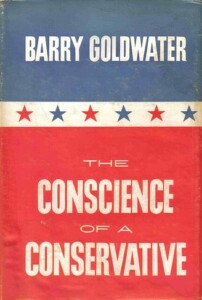
His largely ghost-written 1960 book The Conscience of a Conservative, a slim 123-page volume, espoused a laundry list of conservative positions on education, labor, civil rights, agriculture, social programs and taxation. To like-minded conservatives of the era, it was inspiring, in effect their Project 2025.
However he was labeled, his followers at the GOP convention in San Francisco that summer were in lockstep. New York Gov. Nelson Rockefeller, a liberal Republican and a certified member of the hated Northeast Republican establishment, was booed when he tried to speak. He countered above the din, “This is still a free country, ladies and gentlemen.” As indeed it was. Rockefeller lost the nomination – no surprise — and Goldwater the election, in a landslide.
Although he retained his Senate seat, liberal Republican Sen. Hugh Scott of Pennsylvania was also at a loss. There was enough soul-searching after Goldwater’s crushing defeat to inspire Scott and other moderate Republicans to reassess the party’s future. He even wrote a book, Come to the Party, which he inscribed to me after I’d interviewed him for a profile in Philadelphia Magazine. The article was not flattering. I preceded it with a quote attributed to Alice Roosevelt Longworth: “There are two things I like about Hugh Scott. His face.” His prescription for a more moderate GOP did not win the day.
Goldwater voted for the civil rights acts of 1957 and 1960 and for the 24th amendment outlawing the dreaded poll tax that had been used for decades to disenfranchise Black voter in the South, but he voted against the 1964 Civil Rights that outlawed discrimination in public accommodations and employment. His lop-sided defeat solidified the South as a Republican stronghold for generations and led 16 years later to the election of former liberal Democrat turned conservative Republican, California Gov. Ronald Reagan to two presidential terms.
After a five-year sabbatical from Washington, Goldwater returned to the Senate in 1969, succeeding Arizona’s retiring seven-term Democratic senator Carl Hayden. While Goldwater then focused on defense and foreign policy, he had another important role to play. In 1974, as President Richard Nixon faced impeachment and removal from office for crimes related to the Watergate scandal, Goldwater was one of the Republican senators who urged him to resign. In 1986, he oversaw passage of a bi-partisan bill to strength civilian control of the military.
After leaving the Senate in 1987–succeeded by John McCain–he took a leftward turn, supporting environmental protections, gay rights, abortion rights, legalizing marijuana and homosexuals serving openly in the military, an array of positions some have described as more libertarian than liberal. It is worth nothing, however, that none of these positions would pass muster with the Maga crowd and the current administration in Washington.
But that was the evolving conscience of a conservative.
Barry Morris Goldwater died March 19, 1998, at the age of 86, in Paradise Valley, Arizona.
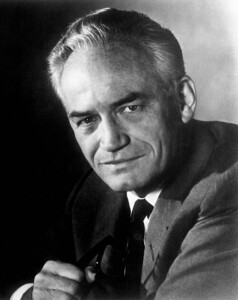
Barry Goldwater in 1960
Gene,
The convention that nominated Goldwater was particularly nasty to Black Republicans. The former Dixiecrats turned Republicans had already evicted long-standing black Republicans from party posts and, in many cases, from delegate posts. At the convention, the Southerners named their caucas Ft. Sumter. Southerners spat on black delegates, called them N’s, and physically assaulted them. Jackie Robinson famously said of the convention, “Now I know what it felt like to be a Jew in Germany.” I don’t think Goldwater was a racist, but he accepted racist support and was avid about recruiting former Southern Democrats angry at the Civil Rights Bill of 1964. I’ve long thought if the Republicans had stood by their civil rights tradition, the Dixiecrats would have been isolated and read out of American politics instead of being at the Republican Party’s and MAGA’s core.
The Southern Strategy, developed by Kevin Phillips for Richard Nixon’s 1968 campaign, was too effective to ignore. But what turned into MAGA, only came about because Democrats turned their backs on working people and labor unions. After Reagan’s election in 1980, leaders like Rep Tony Coehlo, created the Democratic Business Council to build support, both financial and policy, for the Party. As AFSCME’s Policy Director, I asked Coehlo and his staff to be part of the council. I said business and labor needed to know and hear from each other to build together.
“No way,” they said, “ business doesn’t want Labor in these meetings with Members of Congress.”
Fast forward to Bill Clinton’s refusal to listen to Labor about NAFTA, making no changes that could help workers and unions. It was hardly a surprise when, in 2016, campaigning door-to-door in Pennsylvania, union members told me they’d had it with the Clintons and that Obama hadn’t helped them with their under water mortgages and lost jobs. “Obama bailed out Wall Street and Trump talks about my problems, so I’ll vote for him!”
Now, while we do our best to stop Trump’s destruction of democracy, working people will see what his economy has in store for them. The Democrats need to be ready!
Thanks for reminding us, Gene, of what classic conservatism stood for. I met Goldwater twice, once as a young Republican in high school when I was canvassing for him in Manchester, and the second time about 20 years later (when I had become a liberal Democrat) and I interviewed him for an article I was writing for Washingtonian Magazine. Despite our political differences by then, I still respected him and left the interview with a sense of continued admiration for, as you point out, a principled man who lived and acted according to his conscience. (I wish I still had my tattered copy of Conscience of a Conservative!).
Well said, as always, Geno-O.