Black History Month Is Canceled…
…at Harpers Ferry.
The February calendar at Harpers Ferry National Historical Park is blank. No events scheduled. Until after this Jan. 4, every Sunday featured an hour-long history talk (“The Story Behind the Scenery”) given by a Park Ranger recounting the significant role of the former federal arsenal town in the fight to end slavery. Notably, the Park Service also annually had held a mid-October weekend of events commemorating John Brown’s Oct. 16-18, 1859 raid, in which he and a small band of 18, including five African Americans, seized the town and attempted to incite a slave insurrection to topple the hated institution of slavery.
But that event (“Sacrifices & Circumstances: 165th Anniversary of John Brown’s Raid on Harper’s Ferry“) had been “CANCELED,” according to the official Park Service website. Welcome to the Trump’s Orwellian revisionist history, in which America’s sins are either sanitized or completely erased from public view.
The times they are a changing–and not for the better. Yet, history lives on, in often surprising ways.
Descendants of Dangerfield Newby, the first of John Brown‘s raiders to fall at the Ferry, have been telling the story in fictionalized accounts that evoke the past and resonate in the present, at a time when the fight for freedom remains more urgent than ever. It’s a complicated story to tell, but let’s begin.
At 39, Dangerfield Newby was the oldest of the five African Americans with Brown. He was a man of mixed race–his mother Elsie Pollard was enslaved, his father Henry Newby was a white slaveholder in Culpeper County, Virginia. Elsie’s owner was another man, John Fox. Still, Henry and Elsie lived as husband and wife and had 12 children, of whom Dangerfield was the oldest. A blacksmith by trade, Dangerfield established a relationship with a slave named Harriet owned by a Dr. Jennings in Brentsville, in adjoining Prince William County, and they had as many as seven children.
Then, with permission from Fox, Henry Newby moved his family to the free state of Ohio. There Dangerfield sought to raise money to purchase Harriet and their children, an effort that became more urgent when he learned that Jennings planned to sell Harriet and their children south, where conditions were much worse for the enslaved.
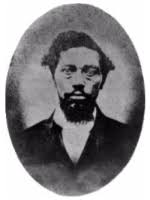
Desperate to raise money to buy his family, Dangerfield plied his blacksmith skills throughout Ohio, but Jennings kept raising the price. Then Dangerfield met John Brown and joined his raid on Harper’s Ferry in a quixotic attempt to free his children and Harriet, who wrote that he was her “one bright hope.” That, of course, did not happen. After Dangerfield’s grisly death, Harriet and the children were sold south to a Louisiana plantation owner. She remarried, to a member of the U.S. Colored Troops from Berkeley County (now West Virginia). They had three more children, and she died in 1884 in the Mount Vernon area.
But her descendants survived.
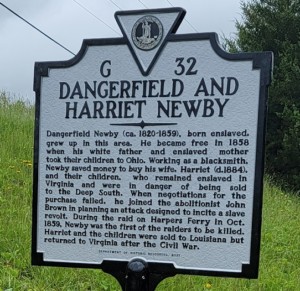
Their story comprises an essential part of my non-fiction book Five for Freedom: The African American Soldiers in John Brown’s Army and led to a state highway plaque being placed in May 2021 in northwestern Culpeper County, near Dangerfield’s birthplace.
In my research, I met descendants Sherrie Carter, who ran a crafts shop in Warrenton, Fauquier County, Virginia, and Ashton Robinson 3d, who lives in tiny Cannonville, Utah.
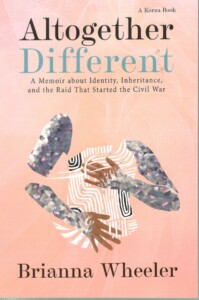
And then, in March 2025, I met Brianna Wheeler, from Portland, Oregon, at Harper’s Ferry, where we both spoke to a receptive audience about the events of 1859 and their aftermath. More recently, I became acquainted with Terry Newby, a lawyer who lives in Roseville, Minnesota, a suburb of Minneapolis-St. Paul. Terry has written a roman a clef based on his own family history entitled Dangerfield’s Promise.
Both authors, according to family lore, are descended from Dangerfield and Harriet Newby, and both have published books based on what they were told is their legacy — and their ties to the man, Dangerfield Newby, who gave his life to free his family from slavery. The journeys of both authors began with stories handed down by their grandmothers. Brianna’s book, Altogether Different, as she writes, is a “unique blend of memoir, creative nonfiction and illustration.”
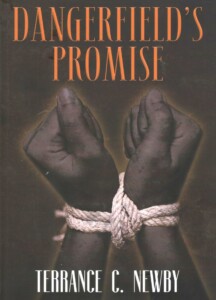
For the protagonist in Terry’s book, a Dr. Thomas Turner, based loosely on himself, “there’s a modern thread to this story,” he told me. “The theme is the past isn’t the past, not even over. We’re living all this stuff right now. What’s going on here in Minnesota with ICE is insane. I live in a suburb, and ICE has been in our city. I’m an African-American man, and I know what it’s like to be profiled by the police. ICE is going after mostly white women and detaining them. These are white people standing up aga9inst an injustice, the same as John Brown did. Look what happened to Dangerfield in John Brown’s raid fighting against the institution of slavery. He felt he had no choice but to take action against an unjust government institution. People protesting ICE are doing the same thing.”
Newby is currently working on a sequel, to be called Dangerfields’ Progress, based on what happened to Harriet and their children after the Civil War.
I urge you to buy and read both books, and I also invite you to buy Five for Freedom, for the full story of the five African Americans who went with John Brown to Harper’s Ferry in October 1859, the world into which they were born and raised, their lives and deaths and the aftermath right down to the present day. It is a story from the past that is now more relevant than ever, as malevolent forces seek to erase our history on the eve of our country’s 250th anniversary. For those who prefer not to buy from Amazon, Five for Freedom is also available for purchase from Bookshop.org.
P.S. I am now also posting on Substack. Some overlap but mostly new and different. I invite you to subscribe. Find me here.
Has someone done a survey of national parks, whether they had recognition of February as Black History Month, and whether they were disappeared?
There’s a wonderful group called Save Our Signs that is building a People’s Archive of signs at national parks around the country:
https://sites.google.com/umn.edu/save-our-signs/home
I went to Harpers Ferry earlier this year and took a bunch of photos of the signs about Storer College and the Harpers Ferry meeting of 1903 led by WEB DoBois, part of the Niagara Movement, precursor to the NAACP. I uploaded them to the Save our Signs site.
There’s a similar effort for the Smithsonian museums, called “Citizen Historians for the Smithsonian” — they got hundreds of volunteers and seem to have the Smithsonian pretty well covered. But everyone should volunteer and get the newsletters…besides just photographing the situation as it existed right before the inauguration of President “We’ve Seen a Lot of Good Things Lately from Frederick Douglass”, we also need people to cover the continuing efforts got erase and rewrite.
Thanks, Gene, for your contribution to the effort!
I was paraphrasing…had to go back and check President Trump’s comment on Douglass. The exact words were more like “he’s done an amazing job and we’re hearing more and more good things about him”
https://www.youtube.com/watch?v=Ujbv4WKIeXE
I also had a typo in DuBois (just to brag that I know more about Black history than Trump does, if that is indeed a brag)
They cancelled the 165th anniversary of Harper’s Ferry at Harper’s Ferry NHP?!!?!? Just…cancelled it? That is astonishing and horrifying.
You may remember me from the Dangerfield and Harriet Newby marker…in fact, I’ll be doing a Harriet & Dangerfield lesson in a couple of weeks with some new History Hunters at the school where I am a librarian! My 4th graders read two books about Ona Judge this year, another important person from history who some of my former students successfully nominated for a Virginia historical marker, a woman from Fairfax County who had been enslaved by George and Martha Washington at Mount Vernon all her life, and who escaped from the Washingtons in Philadelphia during his first term as President. She was never caught, despite their determined efforts to capture her over many years. The students got to see history be erased right in front of us when the Trump administration ordered the NPS to remove the signs telling Ona Judge’s story from the President’s House site in Philadelphia. (It has now been partially restored thanks to a lawsuit, but who knows…)
The disappearance of other Black History related events at NPS sites that I follow has been quieter but feels noticeable. Fort Washington in MD did do a series of Black History events this month, thank goodness. The Frederick Douglass site did one big event for his birthday, and Carter Woodson NHP and Mary McLoud Bethune Council House NHP did a joint event at MLK public library at the beginning of Black History Month. Notably, the Carter Woodson House is STILL not open to the public…it was supposed to be re-opened after restoration years ago, but there seems to be no end in sight for the shuttering of the house that is supposed to preserve and interpret the story of the father of Black History Month himself.
Over the summer, Glen Echo Park was unstaffed by NPS on the couple of times I visited, and when I went over to the Clara Barton NHS next door to see the NPS ranger there, they had none of the Civil Rights Junior Ranger books or Civil Rights badges available. That was an excellent NPS program that told the story of the civil rights protests at Glen Echo in a way that felt really accessible for children. The Ranger clearly did not feel comfortable with answering whether the program had been completely discontinued or whether it was just a badge and book shortage…”I can’t say”…”you can’t say, as in you don’t know?”…”I can’t say.” Glen Echo had already removed its land acknowledgement sign by then.
Even the Maggie Walker National Historic Site and Booker T. Washington National Historic Site didn’t have special events listed, as far as I can see. Granted, Black history is American history all year long, so they don’t * have* to do special programs during Black History month. But as I was doing a roundup of events in the DMV and across Virginia, the dearth of NPS-sponsored events was really noticeable.
Thank you for this comment! May I suggest you check out Petula Dvorak’s “The Persisters” on Substack. She was among the Post’s local columnists let go, and she is celebrating 250 “persisters” leading up to the country’s 250th anniversary in July. I recommend her also to anyone reading this.
https://shorturl.fm/znM01