The Bicentennial +50 – Looking Back and Ahead
The Bicentennial was 50 years ago. Planning for it was contentious. We are now on the cusp of the 250th anniversary of the Declaration of Independence, our semiquincentennial, if you will. What could possibly go wrong?
With an autocratic administration whose leader has almost casually taken us to war, the forthcoming anniversary is emerging for discussion in the public square, thanks in part to an article in The New Yorker magazine on “How the Bicentennial was won.”
Writer Jill Lepore looks at our 1876 Centennial, dominated by a Philadelphia fair celebrating the country’s mechanical achievements (so many sewing machines!), while papering over its lingering divisions, as Reconstruction reforms were yielding to Jim Crow laws. Since the Declaration of Independence had been signed in the city, celebrating its centennial there seemed to make sense, whatever flaws were hidden at the site in Fairmount Park.
The 150th anniversary in 1926 was barely celebrated and quickly forgotten. Which brings us to the 1976 Bicentennial, during which accidental president Gerald Ford opened a century-old time capsule. The contents, it turned out, were a big disappointment. Nothing to see here, move on.
Or look back. As it were, I was thrust into the battles over the Bicentennial in 1972. As a former reporter in Philadelphia by then working at The Washington Post, I had a special interest in the subject, as the City of Brotherly Love sought and failed to recapture its 1876 anniversary prize. On May 18, 1972, I published a lengthy editorial page column in The Post entitled “Philadelphia: No Site for 76” with the subhead “Did National Politics Foil the Fair?” A month later, a local police story in Washington suddenly overshadowed the fair fight.
Then, suddenly, Watergate.
The Watergate break-in had just taken place, on June 17, and my colleagues Bob Woodward and Carl Bernstein had just reported its hazy White House connection in The Post. It was also a presidential election year, with Richard Nixon seeking a second term he would, ultimately, not finish, thanks to the dogged reporting of “Woodstein” and the White House tapes that led to an impeachment vote in committee and moderate Republican senators telling him to resign.
But during the summer of 1972 the worst was yet to come for the 37th president, whose press secretary was dismissively referring to the Watergate break-in as a “third-rate burglary.” The Democrats, meanwhile, on July 13 nominated South Dakota Sen. George S. McGovern, an outspoken opponent of the Vietnam War. McGovern’s VP choice was Missouri Sen. Thomas Eagleton, who was dropped from the ticket just 13 days later after disclosures that the senator had on three occasions been hospitalized and received shock therapy for depression.
Into this toxic stew, I had written a long article for the Washington Post’s prestigious Sunday Outlook section. It was published on July 1, 1972, under the headline “The Big Birthday Bungle.” I reported that Nixon had larded the Congressionally-created American Revolution Bicentennial Commission with Republican contributors and corporate conservatives (and only one black member).
Nixon also had shortened the era, which was initially to run to 1983, with the bicentennial of the adoption of the Constitution in 1783, to five years/ Thus the Bicentennial Era would culminate on Jully 4, 1976. It was meant, I wrote, to “be the capstone of a second Nixon term.”
Then one day, Erwin Knoll, the Washington editor of The Progressive magazine, and Jeremy Rifkin, a 27-year old activist who would become the face of something called the People’s Bicentennial Commission, walked into the office of Managing Editor Howard Simons. They brought with them boxes of internal documents obtained from a source at the ARBC. What they had in mind was a full-scale exposure to run in Washington’s newspaper of record.
Soon I was doing a literal deep dive into the documents and producing a three-part front page series that ran Aug. 14-16, 1972. First day headline: “Bicentennial Commission: Deeply Involved in Politics.:” Day Two: “Bicentennial Commercialism: Red, White, Blue—and Green.” Day Three: “Diluting the Spirit of ’76. Bicentennial Plans Avoid the Controversial.”
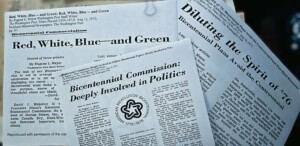
The series generated two Post editorials, many letters to the editor, and several news stories that ran mostly in the Metro section. Rhode Island’s Democratic Sen. John Pastore resigned from the ARBC because he didn’t “like the general smell of the thing.” The Congressional Black Caucus decried the lack of minority representation. Rep. Lawrence G. Williams (R-Pa.), an ARBC member who had criticized the panel, nonetheless decried “political attacks” by “a group of liberal Democratic senators.” It seemed like a tailor-made presidential campaign issue.
Earth to George!
So where was George McGovern? I had sought his reaction on Monday, Aug. 14, the day the series began. He made no comment until Thursday, four days later, when his office issued a tepid statement attacking what he called the “Nixon-controlled” commission as a corporate and political tool of administration supporters. A month later, campaigning in Philadelphia, he issued another statement criticizing various commercial ventures fostered by the bicentennial commission, but, as I reported, “in his speech he gave the subject only passing reference.”
And that was it. McGovern never recovered from the Eagleton disaster, Nixon carried every state but Massachusetts, and Watergate would take many more months to unravel.
The Bicentennial scandal, it seemed, would not long endure. The series did result in reforming the embattled Bicentennial Commission, which hobbled on to its appointed date with destiny, July 6, 1976. On that date, the Post reported, “Independence Day found the United States at peace with itself, as well as with the world outside.” “America Joyfully Toasts Birth of a Nation,” was the front page banner headline. There were fireworks galore, viewed by millions on television, while the People’s Bicentennial Commission held a small rally on the Mall.
With Nixon’s resignation in August 1974, the Bicentennial celebration would not, of course, be “the capstone of a second Nixon term.” By then, however, Ford had pardoned him and declared that “our long national nightmare is over.”
As we are now months away from the 250th anniversary of the Declaration of Independence, with all its lofty words and democratic aspirations, the country faces yet another “long national nightmare.” Already, Donald Trump’s menacing face is on banners coupled with “250” hanging on federal buildings in downtown Washington, as if to say “Big Brother Is Watching You.”
Will the upcoming semiquincentennial be “the capstone” of a second Trump term?
And, if so, what will there be to celebrate?
Let’s send him the Declaration of Independence substituting his name for King George’s.
I have a McGovern-Eagleton campaign button in my collection, along with “Nixon’s The One”. At his son’s swearing-in in the Maryland General Assembly as a member of the House of Delegates, I ended up standing next to Ambassador Shriver and told him I had his campaign button, too.
Unfortunately, the speed at which our democracy is unraveling does beg the question: “What will there be to celebrate?” I’m very thankful that, although our country’s “checkered” history over the past 250 years has revealed many of its imperfections, I have witnessed sincere attempts to recognize and address them by many in positions of power within both parties. My sympathies lie with the younger generation which witnesses only the disrespectful, dismissive and divisive behavior that is so proudly exemplified by this President and those who champion his causes toward those who disagree with him.
Gene, Thank you for the thoughtful walk down memory lane.
As new new faculty member at the University of Maryland and a newly elected local official, I was full of enthusiasm, personally and for our Country’s future, as we celebrated the Bicentennial. Yes, I saw the problems and the immediate challenges, but I am what my friends call a “hopeless optimist.”
Fifty years later I serve as Chair of Maryland”s 250 (Semiquincentennial) Commission. While I remain a “hopeless optimist,” I do fear the future of our democratic republic is very threatened.
The last several years and the near future are times fraught with dangers. It is time for all of us to pull together in the strongest way to defend our basic principles of governance—to protect them and expand them by defending an even stronger inclusive and diverse democratic republic. Parris
https://shorturl.fm/FEHZ2