Mississippi’s Last Black U.S. Senator is Buried in DC
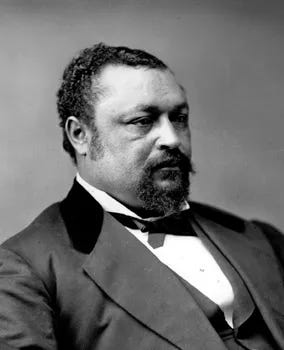
Bruce is said to have attended Oberlin College for two years, then was a steamboat porter on the Mississippi River, moving in 1864 to Hannibal, Missouri, where he established a school for black children. In 1868, he moved to northwestern Mississippi, where he owned a plantation spanning several thousand acres. There followed a string of appointed and elected positions. He also edited a local newspaper. He was not Mississippi’s first Black senator. Hiram Revels held the position in 1871-1872, but Bruce was the first to serve a complete six-year term.
The victory of Democrat Scott Colom this week to be the state’s first elected Black United States Senator is a remarkable milestone in the struggle for democracy in the Deep South. It comes 62 years after the “Mississippi Summer” of 1964, when more than 700 young civil rights activists — Black and white — converged on the state to help register Black voters. Three young men seeking to register them, one Black, two white — James Chaney, Andrew Goodman, and Michael Schwerner — paid with their lives. It was one crime among many others that would go unpunished for decades.
In 1964, only 5.3 percent of eligible Black voters were registered. That summer, despite registration efforts, only 1,200 Black voters were successful, out of 17,000 who applied. Fast forward to today. Mississippi’s population is 39.96 African American and 56.30 percent white. Yet, the poorest state often described as the nation’s “most polarized” managed to overcome its presumed bias and destiny to elect Colom.
With Colom’s stunning victory, it seems timely to revisit the burial place of Mississippi’s last Black senator. Woodlawn Cemetery, located east of the Anacostia River, is secured by a locked chain-link fence and, except on certain holidays, is accessible only by appointment. I first peeked through the fence in 1998, when I was writing a Washington Post Weekend story on graveyards. I returned in August 2017 to go behind the fence to visit the grave of Heywood Shepherd, a Black railroad baggage handler fatally wounded during John Brown’s October 1859 raid on Harpers Ferry.
Founded in 1895, the 22.5-acre sloping cemetery is the final resting place of many of Washington’s 19th century Black elite. Many of the graves are in disrepair, but Blanche’s isn’t. It sits majestically on the hillside with an inscription identifying him as “Husband” and “Father.” and “true to his every trust.”
After Bruce completed his term as U.S. senator, President James A. Garfield appointed him Register of the Treasury, a position he held from 1881 to 1885. He was the Recorder of Deeds for the District of Columbia, appointed by President Benjamin Harrison, from 1891 to 1894. Bruce was reappointed as Register of the Treasury by President William McKinley in 1897 and served in that position until his death at age 57 in 1898. He was a trustee of Howard University and, argued for integration of the U.S. Army, and briefly served as the Presiding officer of the Senate in 1879. The three-story home he owned in Northwest Washington, built in 1865, was declared a National Historic Landmark in 1975. His wife Josephine Bealle Willson Bruce (1853-1923) and son Roscoe Conkling Bruce, Jr. (1879-1950) are also buried at Woodlawn.

Since Woodlawn receives no government funding, it relies on volunteers, often bringing their own mowers and weedwhackers, to clear brush and care for the cemetery. The Prince Hall Masons of DC and DC alumnae chapters of two Black sororities have been deeply involved in the effort. The Woodlawn Perpetual Care Association, a 501©3 organization, has owned and operated the cemetery since 1972.