Anniversaries of War and Peace
We seem to be in the midst of marking anniversaries when wars ended, gloriously or ingloriously.
Gloriously
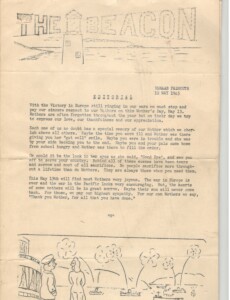
May 8, 1945, some eighty years ago,, V-E Day was celebrated for Victory in Europe — among my first memories. I was not quite three years old, but I still vividly recall watching a military parade from a neighbor’s apartment window overlooking 34th Avenue in Jackson Heights, Queens. Our interior apartment faced a courtyard with a backyard view of row houses stretching along 89th Street. Before V-E Day, we still felt sufficiently exposed to attack from the air for my parents to hang a blackout curtain, more likely a dark blanket, from our rear-facing kitchen window. For V-E Day, Uncle Bernie, in the Navy at Falmouth, England, edited his base newsletter with a special edition. “Bell Bottom Trousers” was a big hit in our one-bedroom apartment. Uncle Sgt. Harry Lampert was deployed to Drew Field in Tampa, Florida, where he sketched cartoons for the base newspaper, after successfully creating the first Flash comic book in February 1940, for which he would later become famous among Golden Age comic book collectors. I had a “V for Victory” suit, and later an “Eisenhower jacket,” which I wish I still had to honor the Allied Supreme Commander and future two-term president.
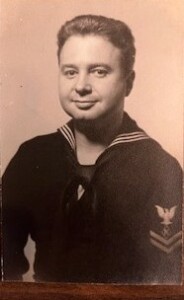
Bernard P. Lampert
Ingloriously
Two wars later: It is 197o. The Vietnam War that Nixon had pledged during his 1968 presidential campaign to end (foreshadowing #47 falsely promising to end the war in Ukraine on Day One), was dragging on. I was then a new reporter at The Washington Post, writing about everything from Potomac pollution to parking, and covering antiwar demonstrations, when Nixon began bombing Cambodia, thus expanding rather than ending the war, and four student protestors at Kent State in Ohio in May were felled by National Guardsmen’s bullets — one unforgettable photograph showed a distraught student kneeling by the body of a dying young woman.
Student protests erupted on campuses across the nation, including at American University and at the University of Maryland. I was dispatched to Ward Circle by AU where police were hurling tear gas cannisters across the circle at students on the other side. The Post had provided reporters with masks, presumably to protect us from the tear gas. Confidently masked, I strode into the middle of this affray, only to discover I had on a dust mask that did nothing to shield me from the more toxic fumes. So I simply joined a line to a first aid tent on the campus, and somehow the protest fizzled more than it had sizzled. I don’t recall what if anything I filed for the paper that day actually got into print on May 7, but it could not have been much. We were told not to become part of the story. My name appeared as one of six also contributing, in italics at the end of the story. The headline on the front page story was “Gas Routs AU Students,” by Sanford J. Ungar, who would years later, in a calmer era, become a university president.
The student protestors at Maryland’s College Park campus were more successful in shutting down not only the campus but also U.S. Route One, which bisects it. I was dispatched there, along with my doppelganger Lawrence Meyer, no relation. It was the only time during our dual employment at the paper that we shared a front page byline. The headline, however, went with students “ransacking ROTC office.” It was “the largest and most violent demonstration in the school’s history,” our May 2, 1970 story said. Nonetheless, the war went on, and on — at home and abroad.
Finally, May 1975
Fifty years ago, President Ford declared our commitment to “save” the Vietnamese from themselves over, in inglorious defeat. The North Vietnamese and Viet Cong have won the war in Vietnam and seized the South Vietnamese capital. Playing out on the television in the Post newsroom are scenes of desperate Vietnamese attempting to scramble from the U.S. Embassy roof in Saigon onto evacuation helicopters. There will be no joyous homecoming for the U.S. troops who, if anything, are disparaged by the left and largely ignored, except symbolically, on the right. They are also victims of this war. My assignment, as the war draws officially to a close, is to go to the Shrine of the Immaculate Conception in Northeast Washington. There a “peace rosary” is said. There are no crowds. There is hardly anyone inside the shrine to mark this solemn occasion, nor did my little vignette marking the end of this inglorious war make the next day’s paper, and I asked myself, “Is that all there is?”
Uncle Bernie’s VE-Day & Mother’s Day Newsletter, 12 May 1945.
With the Victory in Europe still ringing in our ears we must stop and pay our sincere respect to our Mothers on this Mother’s Day, May `13. Mothers are often forgotten throughout the year but on their day we try to exprsss our love our thankfulness and our appreciaton.
This May `13 will find most Mothers very joyous. The war in Europe is over and the war in the Pacific looks very encouraging. But, the hearts and some mothers will be in great sorrow. Maybe their son will never come back. For those, we pay our big highest sympathy. For our own Mothers we say, “Thank you Mother, for all that you have done.”
Thanks for the memories! I was among the AU students gassed at Ward Circle while protesting the expansion of what we then called a “dirty little war.” And I had the dubious distinction of also being arrested at Ward Circle that day. It’s an experience I will never forget.
This morning, I posted a paraphrase of “We had to destroy the city in order to save it.” That fits in somewhere. Thank you for sharing your memories. To quote a translation of Vergil’s Aeneas, perhaps some day it will please us to remember even these things.
Write your memoir, Gene-O.
I vividly remember in the late 1960s (dunno the exact date), when I was marching one evening with my then-husband and two friends around Dupont Circle to protest the Vietnam War. The crowd was very peaceful, if a bit noisy. All of a sudden, policemen on huge horses rushed at us shooting tear gas and arresting some of the marchers. We were able to run away (down an alley, I think) to the apartment house where our friends lived.
We participated in many of the anti-Viet War marches, but this was the only frightening incident that we encountered. Afterwards, we only marched in the daytime and found that if we smiled at the police they would sometimes smile back. I’ve been doing that again during the recent marches and have found the police to be polite. Dunno how long this will last, but I’m not afraid of them.