A Word about “Word Salad.” Plus, Rejections, Part III
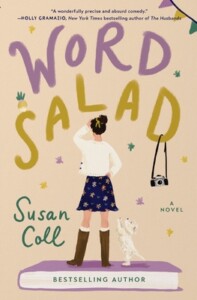
A word about Word Salad. This is the laugh out loud new novel from author Susan Coll. Once again, she has drawn on her longtime association with the indie bookstore Politics and Prose to write what she insists is not a roman a clef. A pivotal event in the book occurs when the narrator, a constantly besieged bookstore event planner, receives a subpoena for an alleged in-store battery.
“You’ve been served!” is the one line she hears as she receives the troubling piece of paper. I have to say that I found this personally triggering, bringing to mind the time I was served in a defamation suit stemming from two stories I’d written while covering the D.C. courts in 1975. “Man of Many Names, Firms Defies City to Collect Tax,” was the Dec. 30, 1975 headline.
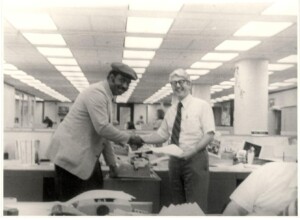
I still have a picture of me being served by a tall Black gentleman in the Washington Post newsroom. In the picture we are both smiling and shaking hands as I accept the subpoena (which, fortunately, was dismissed). At Susan’s P&P launch the other night, I was happy to see my long-ago former Post colleague Jackson Diehl, now retired, who as a summer intern was first assigned to my Prince George’s Bureau and saw the picture on my desk before he’d met me. “I didn’t know which one was Gene Meyer,” he recalled.
Rejections, I’ve had a few. Part III
I’m grateful for the many opportunities I’ve had as a writer, reporter and author over a decades long career. But along with acceptances have come, inevitably, rejections. Some are blunt and dismissive, others thoughtful, considerate and constructive. In this post, I print some that other authors have graciously shared in response to my request for their own rejections.
From Andrew Kreig: When I was a newspaper Sunday magazine deputy editor (Hartford Courant, Sunday Magazine), one of our columnists remembered in print a great one he’d gotten from a junior editor at another publication. “The editor says your article sucks. But I’ve seen worse.”
From John Gilstrap: I started collecting rejections in the mid-90s, during the days of mailed queries and self-addressed stamped envelopes. I was stunned by how impersonal the rejection process was. But the rejection that stands out as the most impersonal EVER came from a NY literary agent. When I opened the SASE, I found my own query letter with a rubber stamped “NO” down by the signature block. On the lighter side, the book she so harshly rejected was Nathan’s Run, which went on to become an international bestseller.
From Bob Reiss: My favorite? My film agent was trying to sell film rights to one of my novels some years back. She’d submitted it to Original Films. The reply came back. “This is too original.”
From David O. Stewart: I’ve never had a constructive rejection. As my last agent-but-one said, “No response is the new no.” Earlier in my career, I got rejections with helpful remarks like “not for me.” “I won’t be taking this one.” You know, the personal touch.
***
Andrew Kreig is an author, legal reformer and consultant. He is Executive Director of the Justice Integrity Project, created to improve oversight of federal white-collar prosecutions. He is the author of Spiked: How Chain Management Corrupted America’s Oldest Newspaper.
John Gilstrap is the New York Times bestselling author of 16 novels, including Total Mayhem, Scorpion Strike, Final Target, Friendly Fire, Against All Enemies, End Game, High Treason, Damage Control, Threat Warning, Hostage Zero, No Mercy, and Nathan’s Run. John has also written four screenplays for Hollywood.
Bob Reiss has written more than 20 books, including Purgatory Road, a murder mystery set in Antarctica, The Road to Extrema, a study of the destruction of Brazilian rain forests, The Coming Storm, which focuses on global warming and catastrophic weather.
David O. Stewart is a trial and appellate lawyer for many years who writes history and historical novels. His non-fiction books have won seven awards from historical and literary organizations, including George Washington: The Political Rise of America’s Founding Father, which the Wall Street Journal, called “an outstanding biography” with “clear, often superlative” writing.
More “Rejections” to come. Watch this space.
The immortal Elsie Carper once rejected my application for work with a short letter saying that I had promise as a writer but I wasn’t Post-worthy because, among other reasons, I employed too many awkward metaphors. I assumed there was no Elsie Carper, and that there was a team of jokers at the Post who got together on lunch breaks to write funny kiss-off letters for giggles. That said, it still hurt like a canary.