Rejections, I’ve had a few. But not too few to mention.
Part I.
I’m grateful for the many opportunities I’ve had as a writer, reporter and author over a decades-long career. But along with acceptance has come, inevitably, rejections.
Some are blunt and dismissive, others are thoughtful, considerate and constructive. I cherish them all as benchmarks along the way from my professional past to the present.
In this, and subsequent posts, I’m going to share some of mine and some that others have graciously provided in response to my query in search of, well, “invalidations.”
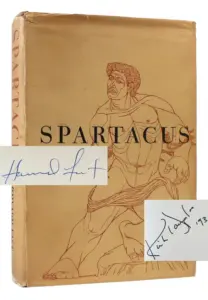
Rejections, I’ve had a few. But nowhere near as many as those received by author Howard Fast for his epic book Spartacus after his Communist Party membership and his refusal to name names to the House Un-American Activities Committee resulted in his blacklisting.
Fast had been convicted of contempt of Congress and imprisoned for three months for refusing to divulge names of contributors to a fund for orphans of American Spanish Civil War veterans. Fast’s editor at Little, Brown lavishly praised the book privately to Fast, but, after pressure from J. Edgar Hoover, the book was rejected.
The story is about a slave and gladiator who leads a rebellion against the corrupt Roman government during the time of Julius Caesar.
Viking, Harper and Doubleday were next, with the same results. The president of Doubleday’s bookstore chain told him, “I have just experienced a sickening two hours with a group of yellow-bellied crumbs who constitute the editorial board of Doubleday. They spent an hour talking about how great your Spartacus is and how they have no hope of never seeing another book like it, and then the spent the second hour talking about how they were not going to publish it.”
His advice: ”Publish the book yourself.”
So, after being turned down countless times, including by his former publishers, he self-published the book in 1951. Fast set up his own company to market and sell Spartacus and was wildly successful. He took out an ad in the New York Times Book Review, but first he had to meet with the paper’s censor, “an elderly gentleman who studied my sketch thoughtfully. ‘Doesn’t appear to be anything demonic in it,’ he said. ‘What about the book? Anything about the overthrow of the government by force and violence?’ ‘Not this government. Ancient Rome.’ ‘We’ll take a chance on that.’”
The book was made into a film, the highest-grossing movie of 1960, and won four Academy Awards. It starred Kirk Douglas, who insisted that Dalton Trumbo, a blacklisted screenwriter, be allowed to write and be credited with the script.
Rejections? Fast had more than a few. But he persevered. Today you can buy a copy of Fast’s self-published book autographed by him and Kirk Douglas for $1,697.95.
Elsewhere:
n case you missed it, click here to read my review of Dara Horn’s important new book The Final Solution to the Jewish Question: A Love Story for the Living. She suggests a way forward out of the deep morass of antisemitism. But first, she walks you through thousands of years of Jew hate. It is hard to read, and to see light at the end of her long, dark tunnel, but it’s a thoughtful if painful treatment.