Rejections, I’ve had a few. Here are mine.
PART IV
I’m grateful for the many opportunities I’ve had as a writer, reporter and author over a decades long career. But along with acceptances have come, inevitably, rejections. Some are blunt and dismissive, others thoughtful, considerate and constructive.
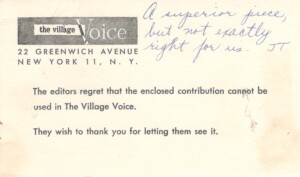
Very early on, in college, I pitched a story to The Village Voice. I didn’t save the story but I saved the rejection, which came on an undated printed card that said, “The editors regret that the enclosed contribution cannot be use in The Village Voice. They wish to thank you for letting them see it.” But then written in pen ink was this: “A superior piece, but not exactly right for us. JT.”
He was no bit player in the publication, I recently learned. Jerry Tallmer was one of the Village Voice’s founding editors and the creator of its Obie awards. He was the paper’s first theater critic and “recruited and edited” Jules Feiffer, Nat Hentoff, Andrew Sarris and Norman Mailer. He left the Voice in 1962 and died in 2014 at 93.
And he had taken the time to personally reject what he wrote was my “superior piece.”
Robert Gottlieb, the editor of The New Yorker, sent me two personal rejection notes in 1990 and 1991. One was for a profile of my late aunt Mildred Meyer, longtime personal assistant to Cosmopolitan editor Helen Gurley Brown, who also wrote poetry, never married and lived and died alone in a n East Side Manhattan studio apartment. “This is a touching story, but I’m afraid it just doesn’t seem like something for us,” he typed. “P.S. I don’t feel your aunt’s poems, and charming as they are, would work for our pages without the story. Again, sorry.” The second was for a story about my father and his collection of 25,000 used books. Again, “I enjoyed reading it, but, alas, I don’t feel it’s something for publication with us. I’m sorry…”
But I remain grateful for the personal rejections. I cherish them both.
Gottlieb worked closely with Robert Caro on his Robert Moses and LBJ biographies. Their collaboration became the subject of a 2022 documentary “Turn Every Page.”
There were others, of course. Robert S. Bird, Senior Editor at The Saturday Evening Post, wrote that a humor piece I’d sent him “isn’t funny… Its structural form is wrong. It doesn’t start with anything arresting or funny, so it isn’t keyed for laughs…And its development flops… But I do think it’s a great subject for a humorous bit, and I think you see the genuine humor in it—you just haven’t got it on paper. I am giving this to you straight out (something I ordinarily never do in rejecting a manuscript) because of our personal contact in the past and, more important, because I think sooner or later we will be printing your stuff…If you’re going in for professional magazine writing you won’t let any of this discourage you one whit.” I honestly don’t recall what I wrote that wasn’t funny,, and I never did publish in his magazine but did in many others.
In 1976, I had co-authored a seven-part series in The Washington Post on Black Lawyers, their struggles, their successes and their contributions to hard-fought civil rights victories. Theirs was a largely an untold story that perhaps in another era would have found a receptive publisher, but not then. Elisabeth Sifton, the top editor at The Viking Press, thought my pitch was “thoughtful and very much to the point.” But she and her colleagues “all felt bearish about the chances for the project. Perhaps it’s a matter of timing—we should all have ben clairvoyant and thought of this project eight years ago? Whatever the reason, the flashing amber light has not turned green,. Of course the other possibility is that all Viking editors are myopic and overcautious…”
Elisabeth Sifton (1939-2019) was the daughter of famed theologian Reinhold Niebuhr and Ursula Niebuhr, founder and chair of the religion department at Barnard College. One of the highlights of my colleague years was a senior seminar with both, with my paper on “Protestant Fundamentalism and the Radical Right” receiving an A, and, little did I know, foreshadowing our current, 21st century ills. Elisabeth Sifton was married to the illustrious German-born historian Fritz Stern (1926-2016), whose European history course I took at Columbia. But I connected none of the dots.
A New York agent I pitched the book to also thought its sales possibilities were “soft.” He suggested instead that I write a book about the white backlash to civil rights victories, particularly in hiring, as the so-called Bakke challenge to affirmative action was all the rage. Well, perhaps a rightwing attack on civil rights would sell then, maybe even more now in our current era of DEI retreat. But that wasn’t our story. My colleague and I countered with “Beyond Bakke: The Struggle for Black Professional Equality.” And there the revised book proposal died before it was born.
“Never Again!” became a repeated demand in the years and decades after the Holocaust destroyed lives of 6 million Jews, including half my family in what is now Belarus. The massacre at Pittsburgh’s Tree of Life synagogue in October 2018 by a neo-Nazi assailant who gunned down 11 Jewish worshippers inspired renewed calls of “Never Again!” And it inspired me to pitch an article to David Rohde, now an MS Now senior national security reporter, then The New Yorker’s online news director.
“Thank you for writing this piece. It is very powerful and moving,” he emailed me on Nov. 7, 2018. “Unfortunately, we don’t run opinion pieces from from non staff writers… This is a strong piece and I hope you find a home for it. Apologies again.”
Not ready to file and forget it, I published the piece as a blog post (“Never Again. Just Words.”) on my website. In 2019, the American Society of Authors and Journalists recognized it as the most Outstanding Blog Post to appear during the previous year. To read it, click here.
Sometimes, persistence pays off. I first applied unsuccessfully to The Washington Post for a summer internship right out of college in 1964. A few years later, I was a reporter for the Philadelphia Evening & Sunday Bulletin where I’d learned a lot about the business in general and the paper’s propensity to live up to what we used to say was its unofficial motto “Lest We Offend.” A Bulletin colleague left to go to The Washington Post, and she suggested I follow her. In 1969 I went to Washington to be interviews by Steve Isaacs, the young Metro editor who was making waves with his activist approach to covering the District. It did not go badly, but I wasn’t hired.
A year later, my former Bulletin friend encouraged me to try again. Hiring at the Post could be whimsical, she said. I contacted the newsroom personnel director, Robert E. Lee Baker, who had covered the civil rights movement in the South. “I thought we’d hired you,” he said. Well, no. He said to come on down. Nixon was president; his hitman VP Spiro Agnew was attacking the press. The backlash spilled over into the newsroom, and Isaacs’ had been replaced by the more traditional Harry Rosenfield.
Harry had been the foreign editor at the NY Herald Tribune when I was the Trib’s Washington Bureau librarian. There he was known as “Harry the Horse” from the Guys and Dolls character. He was a high-energy newsman, whose nephew was a high school pal, and we had met briefly in the Trib cafeteria during college. Harry’s cause was not to have a cause, as he railed against newsroom “causists” who wanted to join antiwar protests the paper also had to cover. He also warned against newsroom liaisons with the spouses of staffers, but that is a whole other story.
Given all that, he brought me on. There was one footnote to my hiring. My namesake Eugene Meyer, the father of Katharine Graham, bought the paper at a 1933 distress sale and built it into what would become one of the nation’s leading papers. Katharine’s son Don Graham and I then referred to each other, respectively, as grandpop and grandson. This rankled his mother at first, but she eventually got over it.
Harry later wrote in his memoir: ““When Eugene L. Meyer applied, I could not resist him because he bore the same name, aside from the middle initial, as Katharine’s father. …Word came down to me that Mrs. Graham was not overcome with glee, not appreciating the humor in it as much as I did… Thankfully, Eugene Meyer had bona fide credentials and went on to perform as a reliable member of the staff.”
BONUS CONTENT: John A. Farrell is a highly-esteemed historian and biographer of Richard Nixon, Teddy Kennedy, Thomas “Tip” O’Neill, and defense attorney Clarence Darrow. He began his career as a newspaper reporter, worked as a White House correspondent and Washington editor for The Boston Globe and as Washington bureau chief and columnist for The Denver Post. Not a bad resume. Early on, however, he sought employment at The Washington Post, and this is what happened:
“The immortal Else Carper once rejected my application for work with a short letter saying that I had promise as a writer but I wasn’t Post-worthy because, among other reasons, I employed too many awkward metaphors. I assumed there was no Elsie Carper, and that there weas a team of jokers at the Post who got together on lunch breaks to write funny kiss-off letters for giggles.”
Note: Elsie Carper (1919-2007) was an assistant managing editor at The Washington Post. She began as a library clerk right after graduating from George Washington University and became head librarian during World War II. She covered local news, education and what was then referred to as women’s news. She encouraged Kay Graham to forcefully succeed her husband Phil as publisher after his suicide. Her last post was essentially AME/pencils/supplies and vetting newsroom applicants. Sidelined from the news, she was nonetheless a pioneer for female “news hens” at a time when the patriarchy ruled.