Rejections, my dad had some.
They could not silence his muse.
Gerard Previn Meyer graduated from Columbia College in 1930 with many honors but no prospects. He spent another year there getting a master’s degree in English and comparative literature and then with his generation emerged into the Great Depression, not altogether unlike those who graduated into the Great Recession of 2008-2009 but much worse. There would be no short or easy path to material or professional success.
He wanted to be a journalist and worked for a year on drug trade magazines, but newspapers along with everything else were in freefall. My grandfather, an educator who would retire in 1949 as p.m. principal of the prestigious Stuyvesant High School in Manhattan, urged him to become a teacher. There at least he could earn a living, while still pursuing his other interests in writing and publishing poetry.
As a young man in his twenties with intellectual if not material ambitions, my dad worked to obtain his teaching credentials, edited camp newspapers where he worked summers, and he published poems and essays in a few highly-regarded if little-known literary publications, including Sewanee Review and The New Quarterly of Poetry..
He applied to the Yale University Series of Younger Poets Competition, directed by Stephen Vincent Benet, who had won a Pulitzer for his book-length Civil War poem, John Brown’s Body in 1928. His subsequent short story “the Devil and Daniel Webster” would be made into a 1942 Oscar-winning film. He won a second, posthumous Pulitzer for Westward, published after his death in 1943 at the age of 44. When my dad applied, Benet was in his late thirties, a literary lion in his prime.
He rejected my dad’s application, but in several letters he wrote the most encouraging messages a disappointed applicant could ever hope for. He even recommended him for another fellowship and to his own publisher. The letters are undated, but one envelope with his home address of 220 East 59th Street is postmarked April 10, 1936.
“I am not accepting your book for the Yale Series of Younger Poets,” he wrote, “but I am doing something else with it which I hope you won’t mind. As I was about to return it to you, my literary agent telephoned me to ask if I knew of any new and promising verse that might be submitted to a New York firm—Reynal and Hitchcock.
“So I have taken the liberty of sending your manuscript along to them—or rather to my agent for transmission to them. I do not know if anything will come of it—but publishers who are interested in verse are such rare birds these days that I thought it worthwhile taking the chance. Of course, if this doesn’t meet with your approval, I’ll be glad to withdraw the book and send it back to you—I haven’t any personal interest in the matter except that it seemed to me that ‘Strange Harvest’ deserved another shot at a publisher. Will you let me know if this is agreeable to you?”
In another letter, he recommended my father for a Houghton Mifflin Literary Fellowship. “I have read Mr. Meyer’s poems with a good deal of interest, and he seems to be somebody worth encouraging. He has decided fluency and can handle the conventional forms as well as the newer ones. I read about 50 manuscript’s a year for the Yale Series of Younger Poets, and, of those, there are perhaps half-a-dozen a year whose names still stick in my mind six months later. His is one of them—and I think his work shows decided promise.”
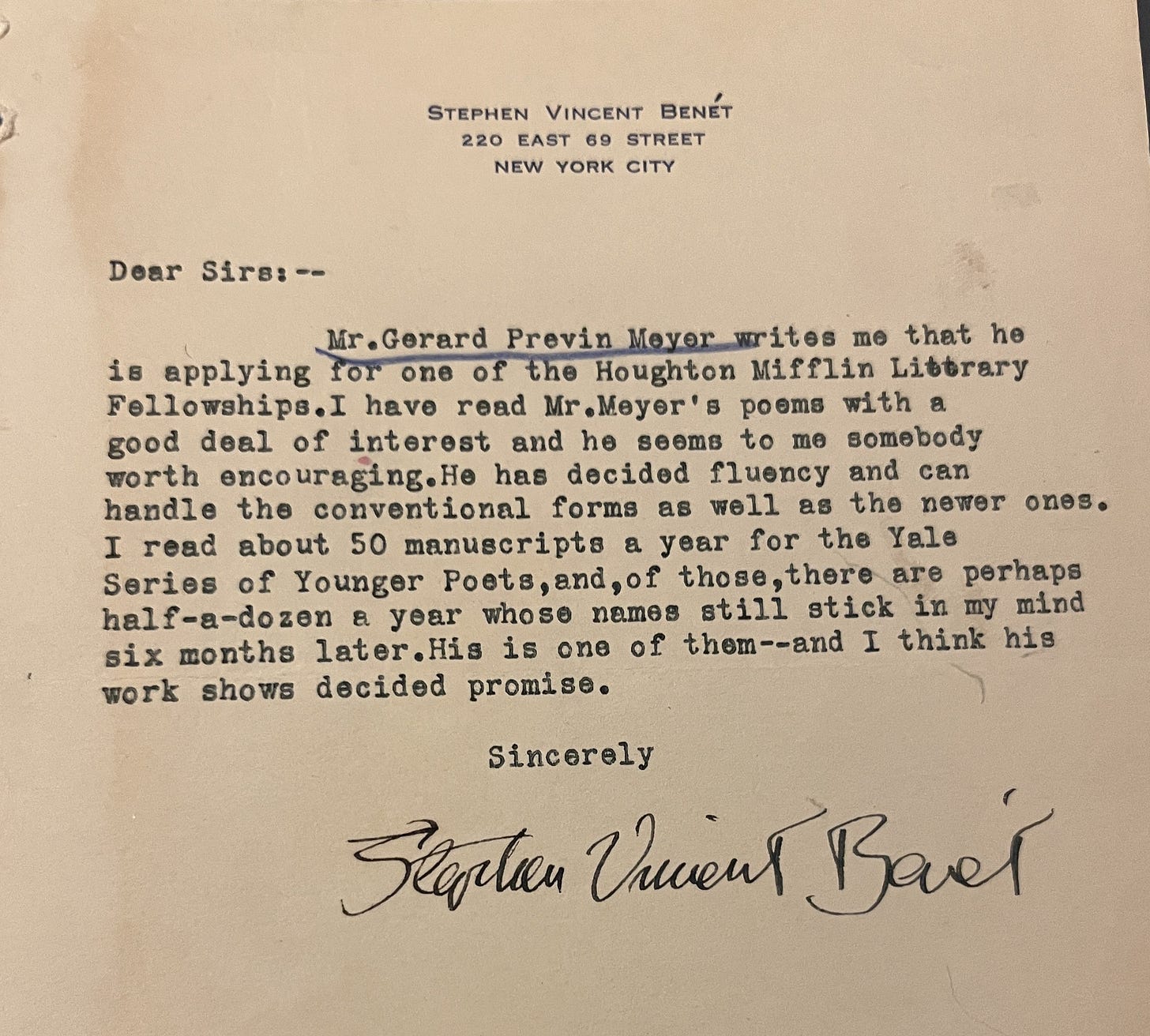
And there was this: “Thank you for sending me ‘Sunday in The Netherlands,’ which I read with interest. It is an interesting little sketch and simply and directly written. It makes its point clearly. But, it is a sketch or an anecdote, rather than a story. And, from the moment the two boys are in the church, and the anomaly of the Truce of God is established, we know how it’s going to turn out. The point is a good one but the point has been made before. Most points have. But the business of the writer is to make them anew, so the reader will feel them anew. I hope his won’t seem harsh criticism. Go ahead and do some more. And dig into your own life for them.”
His harshest comment came in a short note on Yale University Press letterhead. “Gosh, what can I say? I like some of your new work—but liked somebody else’s better. It’s hell being an editor. Sincerely, Stephen Vincent Benet.”
There is no evidence in his crumbling scrapbook containing these and other gems that the poems he sent Benet were published. But he published others, along with reviews and criticisms in Sewanee Review, in 1938 and 1939, and in the New York Times and New York Herald Tribune. Eighteen of his poems appeared in a booklet entitled Inward Armour, published by The League to Support Poetry, in 1939.
The Poetry Society of America, on whose board he occasionally served, published another of his collections as Louder Than the Drum, in 1943. The Poetry of America Anthology, published in 1946, includes one of his poems (“There Is a Street”), as well as one from Stephen Vincent Benet (“American Names”). A nice bit of symmetry.

His love was poetry. His day job was teaching (also later his night job to supplement his modest income). During the war, he twice missed being drafted, first with my birth, then aging out. But he joined the New York City Patrol Corps (“LaGuardia’s Army”) and wrote a patriotic poem “Keep ‘Em Flying,” which he sent to President Roosevelt while teaching at Corona Junior High School, where it graced the back cover of the January 1942 school graduation book. For a decade in the 1940s and 1950, he regularly reviewed books of poetry for the Saturday Review of Literature.
In 1946, he scored his dream job as a script writer for WNYE-FM, the city’s pioneering educational radio station. From the small classroom reaching a much wider audience, his scripts won many awards, and he worked there for 26 years until he retired. He also wrote and produced children’s shows for television.

In 1960, Macmillan published his Pioneers of the Press, a young adult book he dedicated to me and my sister that was printed in hardcover and paperback. Translated into several languages, it was distributed worldwide by the U.S. Information Agency. And he wrote afterwards and forewords for Signet Classics, including for Robert Louis Steenson’s Kidnapped. For years, the complimentary paperbacks came to our house in Greenvale, Long Island, New York. Except for a few, they are long gone.

Remarkably, and regrettably, I knew little of my father’s literary accomplishments and interior intellectual life, other than his used book collecting, which became quite extensive, overflowing our small, three-bedroom, one-bath ranch house with some 25,000 volumes (including three sets of the Encyclopedia Britannica). Long after my sister and I had graduated from Greenvale and left the nest for our own adult lives, Gerry Meyer was still acquiring volumes, now as a rare book collector.
In 1982, at the age of 73, The Stone House Press, in Roslyn Harbor, New York, published his last book, a collection that is aptly titled Renewals: Selected Poems & Translations. The very name spoke to his determination to keep writing despite the rejections. There are many poems in the collection that speak to me, but one especially is “THEY WHO CAN LOOK ON LIFE.”
They, who can look at life, and unafraid
Wander the ways of living, wherever they go
Through days on which the sun makes a brave show
Or when the rain has set an ambuscade
And sent his arrows: still they go arrayed
In inward armor: though the flesh bend low
Like grass before the storm that starts to blow
There is a spirit that makes high parade.
This sprit, that from wind & rain is shielded,
Outdazzling sun, is nothing we can touch:
But, like a shining sword, from scabbard wielded,
Flashes in flesh, and brightens the dull hutch:
And they who look on life can look on death,
Knowing the spirit has no need of breath.
