The Previn Connection to “The Swedish Connection”
We recently watched “The Swedish Connection,” a film on Netflix that hit home. The film tells the story of a long forgotten Swedish diplomat who cleared the way for a remarkable boatlift that allowed 7,500 Jewish Danes to escape the Nazi death camps, to survive and reestablish their lives during the war in neutral Sweden.
I’ve been working on a biography of the musical polymath and my cousin Andre Previn, born Andreas Ludwig Priwin in Berlin on April 6, 1929. The Berlin Privins were wealthy and, for the most part, lucky. Andre and his immediate family – his parents, brother and sister — made it to America, where my great uncle Charles Previn, musical director of Universal Studios, brought them to Hollywood. Andre went on to win four Oscars, ten Grammys, conduct major orchestras and receive countless awards and accolades, including the Kennedy Center Honors.
But the Previn diaspora brought other members of the family to Brazil, Central America, the United Kingdom—and to Sweden. Long before I knew of the Previn connection, I became aware of the flotilla of Danish boats that ferried their Jewish countrymen to safety across the sound from Denmark to Sweden.
While on a press trip to Scandinavia in January 1970, I interviewed Danish filmmakers producing movies with Danish actors speaking English. The first of these films was called “October 43” but would be distributed in the United States as “the Only Way.” My story appeared in The Washington Post on May 10, 1970 – 56 years ago.
In a villa north of Copenhagen, over glasses of sherry, I wrote, executive producer Mogens Scot-Hansen said, “By the end of September, 1943, the rumor was spreading that by the evening of Oct. 1, 1943, the Danish Jews would be taken away to German concentration camps to the gas chambers. Suddenly, you had to get out of, mostly, Copenhagen, 6,000 people who had just one thing different from the other Danes: they either had the Jewish religion or that their parents or grandparents were Jewish.
(The actual number was 7,500, of 8,000 Jewish Danes, who were largely integrated and assimilated into Danish society, and thus viewed by other Danes as fully Danish.)
“And what we are trying to tell is the story of one family, Stein, the father, mother and 18-year old daughter, which suddenly is faced with the situation of being fugitives in their own country; and the reaction of the…non-Jewish Danes who helped them escape.”
My Eastern European maternal relatives — great aunts and great uncles and cousins — were murdered by the Germans and their local collaborators in their hometown of Volozhin, in what is today Belarus, in May 1942, two months before I was born. Unlike the German Jewish Previns, their countrymen did not save them. Just the opposite.
“The Only Way,” which ran for 86 minutes, was released in the United States on Oct. 20, 1970, with little fanfare, but can now be viewed on Amazon Prime.

In researching my Previn family, I leaned about the Swedish connection. They crossed the strait not in October but two months later, hidden in a fishing vessel.
These were the Privin cousins related to Andre, and, I would learn, also to me.
Klaus Ullrich Priwin had already left Germany in 1933 for Denmark, where he met and married his non-Jewish wife Ellen Anna Jorgensen Merling, with whom he had a son Steen, born in Copenhagen in 1934, followed in 1941 by a daughter Fleur. Klaus’ mother Lucia, by then a widow whose German citizenship had been annulled under the 1935 Nuremberg laws declaring Jews to be stateless, also immigrated to Denmark.
The family managed to make it to Sweden in December 1943. Steen became a film and TV producer, Fleur an art historian.
“My mother told me the story that she was hiding under the cargo of a fishing boat together with her parents and her brother,” Fleur’s son Joachim Palme told me. “The boat was intercepted by the Germans, and they even opened the hatch. However, since it smelled so much of fish, they quickly closed it and went away. Then I heard that the boat drifted into a minefield at sea on the Swedish side, but somehow managed to reach the harbor of Simrishamn, Sweden. From there the family was taken to Malmo and later on to Gothenburg on the Swedish west coast where they settled.”
Steen died May 8, 1995, in Gothenburg, Sweden; Fleur died Nov. 10, 2107, also in Gothenburg. Joachim Palme has since become the Swedish Priwin connection, building a large family tree on MyHeritage that keeps expanding exponentially.
And that is the Previn Connection to “The Swedish Connection.”
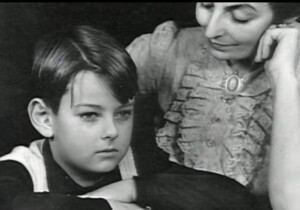
Young Andreas Ludwig Privin and his mother Charlotta, in Berlin, before they fled to France and then to America in November 1938.
Fascinating.
It’s interesting that after serving as chief conductor of the London Symphony, music director in Pittsburgh and Los Angeles, and chief conductor of London’s Royal Philharmonic, Andre Previn wound up his orchestral directorships in Scandinavia as chief conductor of the Oslo Philharmonic. His career was hallmarked by multiple concerts and recording sessions with the esteemed Vienna Philharmonic, but Previn’s four-year tenure in Norway (2002-2006) allowed him to regain a foothold on the European continent before heading to New York for the closing years of his career. Yet another Scandinavian connection for the Priwin/Privin family.
Interesting, thanks. I hope to see the major orchestras in Oslo and Stockholm within a couple of years. Combining typical tourist sightseeing with seeing major orchestras has become my pasttime. Andre Previn’s legacy had not yet been on my radar list but it is now!
Interesting and I’ll need to read your book when it’s published, especially because I hope to visit Sweden in a couple of years. I was just in Copenhagen in May and did some reading beforehand. I learned that while, yes, the Danes did an unprecedented thing in saving nearly all of its Jewish citizens, it was also the case that there were many Danes in the Nazi Party and many Danes whose businesses profited from the German Nazis and helped the Nazi war effort. I also understand that Danes refused entry at the German border to Jews (non-Danish citizens) trying to escape Germany. (How many and whether they allowed some in, I don’t know.) So great in comparison with other European countries? For sure. Entirely without fault? Probably not close.